Grace DOWNE, christened 3 January 1605 in Winkleigh, Devon. Her parents were Richardi DOWN and Johan BRIGHT, and she is my 8 x great-aunt.
Robert DAMARELL, christened 3 January 1802 in Dodbrooke, Kingsbridge, Devon. His parents were another Robert DAMARELL and Elizabeth JEFFRIES, making him my first cousin five times removed.
Betsy SHERIFF, christened 3 January 1808 in Thurlestone, Devon. Her parents were Richard SHERIFF and Ann EDGCOMBE - and I know she fits into my EDGCOMBE line somewhere!
Sarah EDWARDS, christened 3 January 1830 in East Portlemouth, Devon. Her parents were Richard EDWARDS and Mary Ann MARCH; Sarah's older sister Jane married into my BALL line.
Showing posts with label Damerell. Show all posts
Showing posts with label Damerell. Show all posts
Tuesday, 3 January 2012

Friday, 23 December 2011
On This Day: 23 December
Two events to celebrate today: a christening in 1865 and a wedding in 1722.
The wedding first: Michael DAMAREL and Elizabeth Jane got married in East Allington on 23 December 1722 (they are my 6 x great grandparents). The surname is one of those which gets spelt differently as each generation moves on - and even gets spelt differently within each generation, so I have to check for DAMAREL, DAMARELL, DAMERELL, DAMERALL and any variation thereof.
The christening is of twins: Lewis Albert and Augusta Ann EDGCOMBE (another surname with all sorts of spellings!). This christening is marked with a special set of emotions, when I looked at the dates of the other children. Parents George and Mary Ann married in 1859, followed in 1860 with the birth of baby James Henry - who only lived some four months. Bertha Ellen was born in 1861 - but she died of scarlet fever aged only 4. Noah George was born in 1864, but lived for less than a year. And the saddest thing? Little Bertha Ellen's death was registered by her grandmother, because her mother Mary Ann was seven months pregnant with the twins, and was probably not allowed to go near Bertha.
 So there must have been mixed emotions at the christening of Lewis and Augusta. Grief at the death of Bertha only three months before, hope that these two babies would live (they did, growing up to get married and have families of their own).
Here they are (they are my great-great-uncle and aunt) aged about four:
The wedding first: Michael DAMAREL and Elizabeth Jane got married in East Allington on 23 December 1722 (they are my 6 x great grandparents). The surname is one of those which gets spelt differently as each generation moves on - and even gets spelt differently within each generation, so I have to check for DAMAREL, DAMARELL, DAMERELL, DAMERALL and any variation thereof.
The christening is of twins: Lewis Albert and Augusta Ann EDGCOMBE (another surname with all sorts of spellings!). This christening is marked with a special set of emotions, when I looked at the dates of the other children. Parents George and Mary Ann married in 1859, followed in 1860 with the birth of baby James Henry - who only lived some four months. Bertha Ellen was born in 1861 - but she died of scarlet fever aged only 4. Noah George was born in 1864, but lived for less than a year. And the saddest thing? Little Bertha Ellen's death was registered by her grandmother, because her mother Mary Ann was seven months pregnant with the twins, and was probably not allowed to go near Bertha.
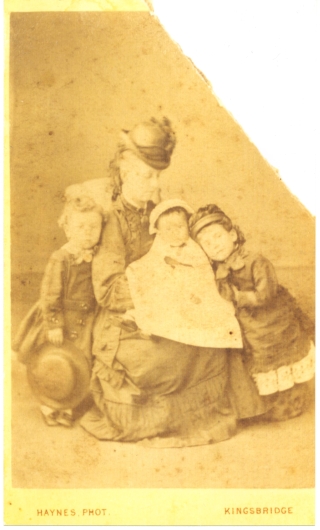 So there must have been mixed emotions at the christening of Lewis and Augusta. Grief at the death of Bertha only three months before, hope that these two babies would live (they did, growing up to get married and have families of their own).
Here they are (they are my great-great-uncle and aunt) aged about four:
Monday, 13 June 2011
Matrilineal Monday: Jane Ball DAMERELL
Jane BALL was one of my great great grandmothers. She was born on 6 October 1831 in Charleton, Devon, and christened in the same place on 23 October 1831. Her first child, Emma Jane, was born in 1850 when Jane was just 19.
On 24 June 1857 - again, in Charleton - Jane married Henry DAMERELL; the witness were Jane Clements and Mary (surname illegible). Her best friends? Henry is recorded as a sailor.
Jane went on to bear seven children, and died on 30 August 1880 - I wouldn't be surprised if this event also occurred in Charleton!

On 24 June 1857 - again, in Charleton - Jane married Henry DAMERELL; the witness were Jane Clements and Mary (surname illegible). Her best friends? Henry is recorded as a sailor.
Jane went on to bear seven children, and died on 30 August 1880 - I wouldn't be surprised if this event also occurred in Charleton!
Monday, 9 May 2011
A Pinch of Salt
Bertha DAMERELL (my great grandmother) died of pneumonia. The story goes that several of her children were ill, and she got up to tend to them in the night, even though she was ill herself...and died shortly thereafter.
Or is this all rather muddled? She was only 51 when she died (the same age as me!), and her death certificate does indeed say that she died of pneumonia, but something just doesn't feel right.
This is an example of how stories that are passed down from generation to generation are not always 100% correct. Several times I have been told a family legend, and then when I have done the names-and-dates research I have found that the dates mean that Person A just couldn't have married then, as they were only five years old, or Person B was dead by the time they were supposed to have completed the task described in the legend...
However, I never discount family stories. Often, they are not complete fabrications, but do have a grain of truth in them, and these grains put together form a clue. Clues put together can often create a research avenue - and then you find the bare-bones truth. For instance: there was the family story of great-great-grandfather being kicked in the head by a horse, and his daughters had to be taken out of convent school because the business was ruined. Actually, they ended up in the workhouse for another reason entirely, along with the sons - but I would never have thought of looking there, if I hadn't had the exciting story of the horse and the convent school - besides which, I had thought he only had one daughter...
Or how about the ancestor who changed his age and ran away to sea? Except he didn't: the General Register Office method of dividing a year into quarters meant that he was registered in a different quarter to his birth - and later he became a coastguard in Ireland...
So my advice to anybody new to research is: take everything with a pinch of salt, but don't discard the salt cellar.
Or is this all rather muddled? She was only 51 when she died (the same age as me!), and her death certificate does indeed say that she died of pneumonia, but something just doesn't feel right.
This is an example of how stories that are passed down from generation to generation are not always 100% correct. Several times I have been told a family legend, and then when I have done the names-and-dates research I have found that the dates mean that Person A just couldn't have married then, as they were only five years old, or Person B was dead by the time they were supposed to have completed the task described in the legend...
However, I never discount family stories. Often, they are not complete fabrications, but do have a grain of truth in them, and these grains put together form a clue. Clues put together can often create a research avenue - and then you find the bare-bones truth. For instance: there was the family story of great-great-grandfather being kicked in the head by a horse, and his daughters had to be taken out of convent school because the business was ruined. Actually, they ended up in the workhouse for another reason entirely, along with the sons - but I would never have thought of looking there, if I hadn't had the exciting story of the horse and the convent school - besides which, I had thought he only had one daughter...
Or how about the ancestor who changed his age and ran away to sea? Except he didn't: the General Register Office method of dividing a year into quarters meant that he was registered in a different quarter to his birth - and later he became a coastguard in Ireland...
So my advice to anybody new to research is: take everything with a pinch of salt, but don't discard the salt cellar.
Monday, 27 December 2010
Maritime Monday: Keeping it in the family
Throughout the previous generations, the BALL family were agricultural labourers. Then they made the shift from the land to the sea - and by the time the generations reach my uncle, to the air as well.
John BALL, christened 2 May 1819 died 21 December 1890, started off working the land like his father before him and his father before that. Then, in his late thirties, he transferred to the sea and was listed as a Mariner in all the censuses from 1851 onwards. But it didn't end there - he was not the only one.
His stepson, Thomas Damerell ELLIOTT, became a sailor in his early twenties, then became a bargeman in his fifties, and a merchant seaman in his sixties.
Another of John's sons, Benjamin, started at ten years old as a shipwright's errand boy, then is described as a shipwright's apprentice in the 1871 census. His brother, Charles, was also a shipwright's apprentice, and youngest brother William was a "shipwright's labourer" in the 1881 census, working in the port of Southampton. There he met my great-grandmother, Bertha DAMERELL, herself the daughter of a merchant seaman who later became a steamship stoker.
The two World Wars managed to interrupt this 'family business', until John's grandson married a woman descended from coastguards, and his great-great-granddaughter married a man descended from shipwrights.
And I have always loved the sea...
 |
| circa 1807 |
John BALL, christened 2 May 1819 died 21 December 1890, started off working the land like his father before him and his father before that. Then, in his late thirties, he transferred to the sea and was listed as a Mariner in all the censuses from 1851 onwards. But it didn't end there - he was not the only one.
His stepson, Thomas Damerell ELLIOTT, became a sailor in his early twenties, then became a bargeman in his fifties, and a merchant seaman in his sixties.
 |
| circa 1840 |
The two World Wars managed to interrupt this 'family business', until John's grandson married a woman descended from coastguards, and his great-great-granddaughter married a man descended from shipwrights.
And I have always loved the sea...
Sunday, 26 December 2010
On This Day: Boxing Day
Richard CLEAVE and Elizabeth BIBBINS (paternal 6th great grandparents) married 1735 in Morchard Bishop, Devon.
Their daughter, Anne CLEAVE (paternal 5th great grandmother) married Richard NOTT 1760 in Coldridge, Devon.
Samuel MURCH and Margaret LITTLEY (paternal 5th great grandparents) married 1774 in Ottery St Mary, Devon. On their first wedding anniversary they buried their six-month-old son, Samuel, on 26 Dec 1775.
James DAMERELL and Elizabeth WOOD (maternal 4th great grandparents) married 1777 in Charleton, Devon.
Their daughter, Anne CLEAVE (paternal 5th great grandmother) married Richard NOTT 1760 in Coldridge, Devon.
Samuel MURCH and Margaret LITTLEY (paternal 5th great grandparents) married 1774 in Ottery St Mary, Devon. On their first wedding anniversary they buried their six-month-old son, Samuel, on 26 Dec 1775.
James DAMERELL and Elizabeth WOOD (maternal 4th great grandparents) married 1777 in Charleton, Devon.
Monday, 20 December 2010
Maritime Monday: From Train Driver to Ship's Stoker
When I was little, most small boys dreamed of becoming a train driver. And in the 1851 census of Charleton, Devon, my great great grandfather, Henry DAMARELL, aged 17, was just that. For the next twenty years, he was a merchant seaman, and later combined his skills to become a stoker on a steam ship.
In the middle of this, in the 1881 census, he is listed as a Marrene [sic] Store Dealer. He must have kept his connections with the port of Southampton, for several of his grandchildren were born there, and his daughter Bertha was married there in 1879 (to my direct ancestor William John BALL).
What is a Marine Store Dealer? The occupation is varied: "A Marine Store Dealer was a licensed broker who bought and sold used cordage, bunting, rags, timber, metal and other general waste materials. He usually sorted the purchased waste by kind, grade etc. He also repaired and mended sacks etc.
Marine Store Dealers were governed by an Act of Parliament 1st. Geo. IV. sec.16 cap.75. Which enacted that every marine-store-dealer shall have his name inserted in legible characters over his shop-door and shall also keep a book in which he shall insert the name and address of any person from whom he shall buy any article.
Apparently Marine Store Dealers were also not allowed to buy full lengths of rope. A search of the "Times" archive brings up many references to them and nearly all were in relation to police courts. In Dicken's "A Christmas Carol" is Joe, a marine store dealer and receiver of stolen goods." [quoted in Rootschat.com]
A less-polite website indicates that a marine store dealer was pretty much a scrap merchant or rag-and-bone man, and that the occupation was often held by those named Gypsies; while the excellent Hall Genealogy Website, which deals in old occupations, lists a marine store dealer as: "Proprietor of a store selling equipment to Mariners. There were also those who aspired to that but who were nothing but junk dealers".
In the middle of this, in the 1881 census, he is listed as a Marrene [sic] Store Dealer. He must have kept his connections with the port of Southampton, for several of his grandchildren were born there, and his daughter Bertha was married there in 1879 (to my direct ancestor William John BALL).
What is a Marine Store Dealer? The occupation is varied: "A Marine Store Dealer was a licensed broker who bought and sold used cordage, bunting, rags, timber, metal and other general waste materials. He usually sorted the purchased waste by kind, grade etc. He also repaired and mended sacks etc.
Marine Store Dealers were governed by an Act of Parliament 1st. Geo. IV. sec.16 cap.75. Which enacted that every marine-store-dealer shall have his name inserted in legible characters over his shop-door and shall also keep a book in which he shall insert the name and address of any person from whom he shall buy any article.
Apparently Marine Store Dealers were also not allowed to buy full lengths of rope. A search of the "Times" archive brings up many references to them and nearly all were in relation to police courts. In Dicken's "A Christmas Carol" is Joe, a marine store dealer and receiver of stolen goods." [quoted in Rootschat.com]
A less-polite website indicates that a marine store dealer was pretty much a scrap merchant or rag-and-bone man, and that the occupation was often held by those named Gypsies; while the excellent Hall Genealogy Website, which deals in old occupations, lists a marine store dealer as: "Proprietor of a store selling equipment to Mariners. There were also those who aspired to that but who were nothing but junk dealers".
Saturday, 17 July 2010
Surname Saturday: Damerell
I have traced my DAMERELLs back to East Allington (Devon) in 1658. part of a farming community, they moved to nearby Loddiswell, then to Charleton and Kingsbridge. Great great grandfather Henry started out as an 'engine rail driver', but soon graduated to the sea, as did many of my ancestors, working as a sailor for nearly twenty years. He later became a marine-store dealer, which in fact sounds posher than it actually is. (It also sometimes refers to gypsies, but I do not think I have any Romany blood in me). Basically, a marine store dealer was a scrap man who sold to mariners.
" A Marine Store Dealer was a licensed broker who bought and sold used cordage, bunting, rags, timber, metal and other general waste materials. He usually sorted the purchased waste by kind, grade etc. He also repaired and mended sacks etc.
Marine Store Dealers were governed by an Act of Parliament 1st. Geo. IV. sec.16 cap.75. which enacted that every marine-store-dealer shall have his name inserted in legible characters over his shop-door and shall also keep a book in which he shall insert the name and address of any person from whom he shall buy any article." (rootschat.com) and was mentioned by Dickens as early as 1836.
Later, he became a stoker in a steam ship, and in fact was still a stoker in his early sixties. He was obviously a very strong man!
" A Marine Store Dealer was a licensed broker who bought and sold used cordage, bunting, rags, timber, metal and other general waste materials. He usually sorted the purchased waste by kind, grade etc. He also repaired and mended sacks etc.
Marine Store Dealers were governed by an Act of Parliament 1st. Geo. IV. sec.16 cap.75. which enacted that every marine-store-dealer shall have his name inserted in legible characters over his shop-door and shall also keep a book in which he shall insert the name and address of any person from whom he shall buy any article." (rootschat.com) and was mentioned by Dickens as early as 1836.
Later, he became a stoker in a steam ship, and in fact was still a stoker in his early sixties. He was obviously a very strong man!
Wednesday, 16 June 2010
Wordless Wednesday: Jane Ball Damerell

Jane Ball Damerell
6 Oct 1831 - 30 Aug 1880
Charleton, Devon, England
(my great great grandmother)
Subscribe to:
Posts (Atom)
You Might Also Be Interested In
-
 This is something many people get confused about. When is it 'immigrate', and when is it 'emigrate'? Let's ta...
 -
 Have you ever written a letter to a man and addressed it to "Fred Bloggs, Esq"? Did you ever wonder how he came to be c...
 -
 This is definitely 'back to basics' - it has to do with when people were born! Sometimes genealogists will be confused because th...